
|
A Question of Ethics A Voice from the Field (female circumcision) Spirit, Religion, and Health |
 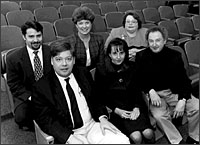 The faculty team for the new interdisciplinary class on health care ethics: (back, l to r, front, l to r) Mr. Robby Jones, Dr. Carol Holbert, Dr. Sarah Freeman, Dr. Timothy Jackson, Dr. Tanya Robinson, Dr. John Banja. |
"Health care professionals, like chaplains, become advocates for the patient," says Sarah Freeman, RN, PhD, coordinator of the School of Nursing's family nurse practitioner program. Crisis arises when those involved disagree on what is ethically appropriate. "For the mutual benefit of the person we're serving--the patient--all members of the team must strive to understand and respect the ethical beliefs of everyone involved," says Freeman. "We have to learn to come up with a resolution that leaves everyone feeling comfortable." This spring, faculty from nursing, theology, and the Center for Ethics in Public Policy and the Professions brought these issues to the classroom by offering Emory's first interdisciplinary course in health care ethics. The university supported this innovative program with a Teaching Scholar Award. The course's value lies in "its ability to enrich students' perspectives on human problems and medical challenges by creating at least a 'bifocal view' of the issues," says James Fowler, PhD, director of Emory's Ethics Center. "The language and leverage of ethics provide nurses with a tool of empowerment. It is a language that appeals to principles and values, one they can use when expressing viewpoints on difficult health care issues." |
 |
 y the very nature of their training, health care providers have a tough time dealing with negative outcomes, with death, says Freeman. "We're taught that the purpose of health care is for people to get well," she says. "Theologians handle the concept of death more easily, as life's natural end." y the very nature of their training, health care providers have a tough time dealing with negative outcomes, with death, says Freeman. "We're taught that the purpose of health care is for people to get well," she says. "Theologians handle the concept of death more easily, as life's natural end."
The changing face of health care delivery complicates the scenario. Greater numbers of advanced practitioner nurses are now delivering primary care, thus forming long-term health care relationships with patients, adds Timothy Jackson, PhD, assistant professor of Christian Ethics with the Candler School of Theology. Based on that strong bond, nurses could find themselves in the difficult moral dilemma that surrounds a request for assisted death. "It is one of the deep crises of patient care," says Jackson. "Does your respect for the patient's autonomy guide your actions, or are there central principles in the practice of nursing that prevent you from acting on the patient's wishes?" Often, people do not recognize how they really feel about certain ethical issues--and how deeply those feelings run, Freeman adds. "When we walk into a patient's room, we don't check our values at the door. In this class, we teach people to recognize who they are. We help them deal with their own value system and how it fits into the big picture." |
 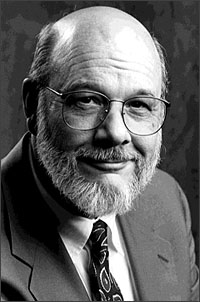 Dr. James Fowler, director of Emory's Ethics Center |
 ot all ethical dilemmas revolve around death and dying, Freeman emphasizes. "Nurses deal with ethics on every eight-hour shift," she says, citing issues of confidentiality as a prime example. "The Nursing Code of Ethics says to hold all things confidential, but sometimes there is information others need to know. Do you tell a woman that her ex-husband has HIV--if you know that he won't tell her?" ot all ethical dilemmas revolve around death and dying, Freeman emphasizes. "Nurses deal with ethics on every eight-hour shift," she says, citing issues of confidentiality as a prime example. "The Nursing Code of Ethics says to hold all things confidential, but sometimes there is information others need to know. Do you tell a woman that her ex-husband has HIV--if you know that he won't tell her?"
Disability and aging carry their own dilemmas. Do you report (to the Department of Motor Vehicles) the elderly patient who is losing her eyesight and thereby jeopardize her independence? Do you take time to get a social worker involved, or do you just ignore the problem? Nurses can help patients find solutions without compromising their own ethical beliefs, Freeman says. "In this class, we stress the importance of handling each situation individually. There aren't just health care consequences in what you do. There are life consequences as well." The advent of managed care has raised troubling issues concerning financial incentives to limit or even withhold needed care, says John Banja, PhD, associate professor of rehabilitation medicine in Emory's School of Medicine. It is important to educate students on the moral issues of health care economics (especially involving the chronically ill and disabled) and on the health care professional's role as advocate for patient welfare, says Banja, who coordinates Clinical Ethics Education for Emory University Hospital. By becoming involved in outcomes research, nurses can contribute hard data that help determine whether denial of treatment is legitimate. "Information that is valid, reliable, and widely shared should be a powerfully persuasive tool," he says. |
 |
 he new ethics course offers what Freeman calls "theoretical real-world teaching." Theories are given, but within the context of actual case studies. "It's easy in the abstract to say that every person has the right to autonomy," she says, "but when you put real names and cases to the test, you see how to apply those theories. That's what's important." he new ethics course offers what Freeman calls "theoretical real-world teaching." Theories are given, but within the context of actual case studies. "It's easy in the abstract to say that every person has the right to autonomy," she says, "but when you put real names and cases to the test, you see how to apply those theories. That's what's important."
While ethics theory provides a framework for dealing with everyday problems, Freeman adds, "it also gives us a desire to deal with the problems. It's easy to say, 'I don't have a choice, I have to report the woman who is going blind,' without looking at the long-term dilemma. If we simply fall back on the rules without examining the real problem, that elderly woman will lose her independence. The real issues too easily get lost." Ethical issues are never simple, concedes Freeman, a former hospital and public health nurse. "At its core, nursing involves dealing with the personal aspects of people's lives. And like it or not, that also involves a person's spiritual beliefs." |
 |
 emale circumcision--a practice in many African and Middle Eastern countries--is a deeply ingrained tradition signifying purification, family honor, cleanliness, aesthetics, protection of virginity, enhanced pleasure for husbands, and increased matrimonial opportunities. emale circumcision--a practice in many African and Middle Eastern countries--is a deeply ingrained tradition signifying purification, family honor, cleanliness, aesthetics, protection of virginity, enhanced pleasure for husbands, and increased matrimonial opportunities.
In reality, too many botched procedures have caused young girls to suffer hemorrhage, severe infections, gangrene, death, or lifelong health and sexual problems. The World Health Organization (WHO) has labeled the practice "Female Genital Mutilation" and is working to eradicate it. Twenty years ago, Anne Davis, 55N, RN, PhD, was teaching in Nigeria when she first heard of this practice. Often performed by untrained village people such as the child's mother or grandmother, it involves removing the girl's external genitalia. Thorns or catgut might hold the vulva together to form a bridge of scar tissue over the vagina. "I was horrified," she says. "One cannot overlook such a practice, but it is useless to rant and rave. I asked lots of questions of traditional healers who performed the procedure, nonjudgmental questions like, 'Do any of these girls bleed to death from this procedure?' One hopes that some seeds are sown." |
 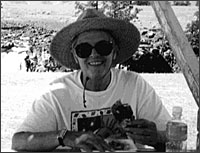 Dr. Anne Davis, 55N |
oday, Davis has spent nearly four decades studying such bioethical issues, traveling in the process to more than 100 countries, teaching at the University of California (San Francisco), and writing what has been called the first modern nursing ethics textbook. Last year, she accepted an invitation to teach at Nagano College of Nursing in Japan where a grant from the Japanese Ministry of Education is allowing her to explore international nurses' perceptions about death and dying issues.
She continues to lecture on the issue of female circumcision, reporting that a small minority of the procedures (12%) is now performed in affluent, urban settings by trained midwives or physicians. The WHO continues to condemn the practice; Davis, who personally abhors it, insists that respect for other cultures is important. Some ethical issues currently facing Japan, she reports, include how to allocate health resources with a growing elderly population "breaking" the national health insurance system. There is, too, the dilemma of whether to tell a patient about a serious diagnosis/prognosis. Most cancer patients, for example, are not told this information due to cultural prohibitions, she says. Japanese values and traditions do not support the principle of autonomy, Davis adds. "The individual is always the socially embedded self, not the autonomous self," she says. "What is is based on a well-thought-out ought. However, little of this has been explicated from cultural values and presented as health care ethics." While the Japan Nursing Association has taken some ideas from the American Nursing Association's code of ethics, the entire code doesn't fit with that society's traditions, she says. "We must be careful with the ought and the is of any society." |
 |
 hen encountering differing cultural viewpoints, Davis acknowledges that the tendency is to "do good," not necessarily to understand how other people see the world and live their lives. "Life and ethics are always in a social context," she says. "This raises the question of tolerance. I don't like intolerance from any source, but if you tolerate anything and everything, you stand for nothing. hen encountering differing cultural viewpoints, Davis acknowledges that the tendency is to "do good," not necessarily to understand how other people see the world and live their lives. "Life and ethics are always in a social context," she says. "This raises the question of tolerance. I don't like intolerance from any source, but if you tolerate anything and everything, you stand for nothing.
"My own position is that I do not have The Truth," Davis says. "I have some truths that come from my own life experiences, which are not the same for everyone. I would not try to enforce anything, but would try to understand, to discuss, to influence, and be influenced by. There is something very arrogant about individuals who want to impose their way on others as if it is the only way. Much harm has been done in the name of a specific definition of good. |
 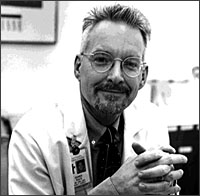 Dr. James Pace |
 ncreasingly, researchers and health care practitioners are finding that religion and spirituality play a more significant role in disease outcomes than once thought. James Pace, RN, DNS, an associate professor in the School of Nursing, has students examine issues surrounding the intersection of religious/spiritual beliefs and the field of nursing in the elective course, "Spirituality, Religion, and Nursing." ncreasingly, researchers and health care practitioners are finding that religion and spirituality play a more significant role in disease outcomes than once thought. James Pace, RN, DNS, an associate professor in the School of Nursing, has students examine issues surrounding the intersection of religious/spiritual beliefs and the field of nursing in the elective course, "Spirituality, Religion, and Nursing."
"Over the years, health care has splintered the person into parts," says Pace. "I think we're seeing the pendulum swinging back to integrate the whole person in terms of health. More research is being done on what religion and spirituality can actually do for people's health. In this age of managed care, outcome orientation, and saving costs, we've seen that spirituality and religious practices are more important to the care of individuals and the outcome of their health then we ever thought possible." On a more basic level, he says, nurses deal with religious issues every day in their practices, where they are often asked to honor religious beliefs in the delivery of care. For example, one faith tradition requires 30 uninterrupted minutes of prayer in the afternoon. "If you have a person who's on IV therapy, who's receiving antibiotics or pain medications and has to be constantly attended by a nurse," says Pace, "that nurse needs to make allowances for prayer time to be honored, yet also deliver all the necessary therapies and treatments." Pace structures his course so that students gain firsthand knowledge of other religious traditions. He asks them to attend an unfamiliar service, meeting, or religious class. "It's interesting to see how someone enjoyed it, or was taken aback by it, or felt like the differences added to their experience," he says. Students also are asked to examine their own beliefs. "I don't think you can effectively deal with other people's spiritual selves until you've really examined your own: what you believe about the meaning in life--the meaning of life--how you discover what is beyond the purely physical," he says. With a half-time appointment as a certified adult nurse practitioner at AID Atlanta, Pace contends with life, death, and spiritual issues daily. He has found working with people with HIV/AIDS "an incredible watershed for the spiritual, which is the base from which all other parts of a person are derived," he says. "To intervene appropriately as their health care professional or advanced practice nurse, you have to become a part of that person's journey and life." by Stacey Jones |
A Nursing Treasure | A Legacy of Scholars | 'A Remarkable Lady'
Missions of the Heart | A Question of Ethics
Newsbriefs | Development News | Alumni News & Class Notes
WHSC
Copyright © Emory University, 1998. All Rights Reserved.
Send comments to
hsnews@emory.edu.
Web version by Jaime Henriquez.