
|
 |
by Susan Carini
In 1975, Loughlin was appointed to the Fulton-DeKalb Hospital Authority. The next day, he became chair of the budget committee for this powerful and controversial group. From 1983 to 1992, he was chair of the Hospital Authority, renegotiating a contract between Fulton and DeKalb counties and Grady and seeing through a bond issue that made much needed improvement and additions to the hospital. His role on the Authority was not without frustrations, some of them bitter. However, there were correspondingly ample rewards. |
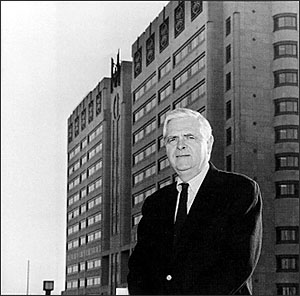
 t is entirely possible that Edward C. Loughlin Jr. never has heard of the Seven Ages of Man. At 63, he is running fast in pursuit of life and, with each turn, establishing a new avenue of achievement. He sat still to be interviewed for this profile; however, the toll that inactivity takes was obvious. After all, this is a man who--in lieu of Norman Rockwell prints of kindly doctors on his wall--has an illustration of himself playing tennis as a "contact sport." Such fearlessness has served him well in his career, where the labyrinthine issues surrounding the administration of Grady Memorial Hospital might have overmatched another man.
  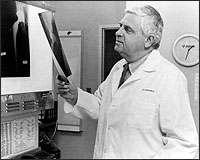 After leaving the Hospital Authority in 1992, Ed Loughlin now continues his 34-year career in medicine in private practice. |
 he origins of the Authority date back to 1946, when the State Hospital Authorities Act gave responsibility for indigent-care services to the counties. The city of Atlanta, which owned Grady, deeded it to the counties. In that transfer, Grady was to get free water service in exchange for providing treatment to city employees without charge. In a contractual agreement, Fulton and DeKalb counties agreed to share resources. The first 30-year agreement was renegotiated during Loughlin's tenure as chair of the Authority. he origins of the Authority date back to 1946, when the State Hospital Authorities Act gave responsibility for indigent-care services to the counties. The city of Atlanta, which owned Grady, deeded it to the counties. In that transfer, Grady was to get free water service in exchange for providing treatment to city employees without charge. In a contractual agreement, Fulton and DeKalb counties agreed to share resources. The first 30-year agreement was renegotiated during Loughlin's tenure as chair of the Authority.
With a budget for Grady in the $60- to $400-million range during Loughlin's tenure, the stakes were unquestionably high. Several factors were responsible for increasing Grady's appetite for operating funds, according to Loughlin. The space program of the 1960s was one factor, especially given the explosion in technology that occurred after the first missions. In addition, the civil rights legislation of that time required that each hospital offer one standard of health care. Finally, the advent of Medicare meant inflationary health care costs. The contract administered by the Authority stated that Grady's operating costs were to be no more than 5 mills of the tax digest. As long as the digest was increasing, Grady operated without problems. However, any time the budget exceeded 5 mills, "reasonable conflict" broke out among city politicians. Years of conflict ensued. Grady posed problems that were physical as well as fiscal. In the 1950s, a new Grady emerged, based on plans drawn in the 1940s, but which had to be tabled while the nation went to war. Since "it was politically incorrect to build a Taj Mahal for the downtrodden," Loughlin says, "even the new Grady was inefficient: it was not air-conditioned; it had 4- and 8-bed wards with limited numbers of bathrooms; it lacked intensive-care units; and--what was most distressing to a more racially unified Atlanta--it had separate facilities for whites and blacks." |
 |
 uring the refurbishment of Grady that began in 1988, the man who wishes to be known as "no shrinking violet" certainly had his time on the political stage. For several years preparatory to the creation of a $279 million bond issue, each need that arose at Grady would be answered with the frustrating words, "Wait for the bond issue." uring the refurbishment of Grady that began in 1988, the man who wishes to be known as "no shrinking violet" certainly had his time on the political stage. For several years preparatory to the creation of a $279 million bond issue, each need that arose at Grady would be answered with the frustrating words, "Wait for the bond issue."
As a result, too much got packed into a single renovation, causing it to go over-budget by some $39 million. Ultimately, however, the thinking that prevailed was that Grady was a strong facility that could be enhanced. But to renovate the 1.2 million existing square feet while adding 600,000 new square feet, and continue to run the hospital required cleverness and skill. Loughlin remains proud that "the investment did result in improved quality of care for patients and improved quality of training for physicians." During his tenure on the Authority, Emory's medical school created three departments: dermatology, orthopaedics, and radiation oncology. In the development of the latter, there was honor for Loughlin. The Woodruff Foundation generously contributed $3.5 million toward construction of the Edward C. Loughlin Jr. Radiation Oncology Center, which was established in 1992. |
 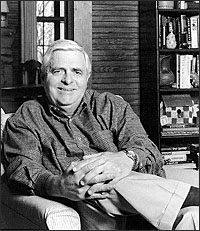 Although retired as chair of the Authority, Loughlin rarely has time to pause for photographs such as this, with a busy private practice and a new managed care venture. |
 fter Loughlin stepped down from the Authority, he acknowledged that it had been "a bit of an ego trip and a fight." In looking back over those years, he credits J. William Pinkston--former executive director of Grady--and Asa Yancey--former medical director of Grady--as his helpers in making difficult decisions. fter Loughlin stepped down from the Authority, he acknowledged that it had been "a bit of an ego trip and a fight." In looking back over those years, he credits J. William Pinkston--former executive director of Grady--and Asa Yancey--former medical director of Grady--as his helpers in making difficult decisions.
Yancey, now emeritus professor of surgery at Emory, notes that "there was no limit for Ed in the number of hours he worked for Grady. He made the hospital a leader in patient care, medical education, and clinical research." Echoing this praise is Pinkston, who notes especially the contribution that Loughlin made to indigent patients by lobbying Governor Joe Frank Harris for attention to that issue. Pinkston adds, "Every decision Ed made was based on what was best for the patients." Loughlin's last act as chair was to sign the purchase option for the Ponce de Leon Center, a facility in Midtown Atlanta that joins under one roof an infectious disease clinic and all the auxiliary AIDS programs that had been created at Grady. As with the renovation of Grady, there were differing opinions about its usefulness, with some of its neighbors fighting against it and with other opponents contending that its presence would invite AIDS sufferers to flock to Atlanta. In protest against the plan, DeKalb County withheld funds from Grady and threatened to sue the Authority. Believing the facility to be "a notable addition to the health care infrastructure of the city," Loughlin never wavered in his support. It intrigued him to see that on the facility's dedication day "there was no problem getting politicians up on the dais to take credit for it." |
 |
 ot every dais, however, is crowded with politicians. Loughlin has had numerous opportunities to occupy the stage throughout his career. He was a successful student, first at McCallie School in Chattanooga, then as an undergraduate at the University of North Carolina, and one of the youngest members to graduate with the 1959 medical class of the University of Pennsylvania. He continued to gather distinction during his training as a surgical intern at Emory University Hospital, joining the Emory and Grady Program to complete a year of general surgery at Grady. He completed an orthopedic residency and worked on the attending staff at Grady before becoming a member of the Fulton-DeKalb Hospital Authority in 1975. ot every dais, however, is crowded with politicians. Loughlin has had numerous opportunities to occupy the stage throughout his career. He was a successful student, first at McCallie School in Chattanooga, then as an undergraduate at the University of North Carolina, and one of the youngest members to graduate with the 1959 medical class of the University of Pennsylvania. He continued to gather distinction during his training as a surgical intern at Emory University Hospital, joining the Emory and Grady Program to complete a year of general surgery at Grady. He completed an orthopedic residency and worked on the attending staff at Grady before becoming a member of the Fulton-DeKalb Hospital Authority in 1975.
In 1992, Emory's Medical Alumni Association gave Loughlin its award for Distinguished Professional Achievement. He has received the Medical Association of Atlanta's Aven Cup and Distinguished Service Award and the Georgia Hospital Association's 1993 Distinguished Service Award. A fellow of the American Academy of Orthopaedic Surgeons, Loughlin is immediate past chairman of orthopaedics at Piedmont Hospital, past president of the Georgia Orthopaedic Society, and current president of the Peachtree Orthopaedic Clinic. H. Herndon Murray practices at the clinic and notes that Loughlin is a man of "unquestioned integrity. People may not always agree with Ed Loughlin, but they inevitably come to respect him." |
 |
 egarding Grady's future, Loughlin does not hesitate to speak his mind. First, he believes that the hospital should be a major resource for the 18 metropolitan counties for Medicaid. "The funding base of Grady has to enlarge," he urges, "as well as the patient base that the hospital serves." He further notes, "The state should have appointments to Grady's board. That would be a very sobering and stabilizing influence." As Loughlin sees it, governance of the hospital is critical. He identifies a need for involvement by the upper stratum of leadership in the state, including "the governor, the Woodruff Foundation, the chairs of banks and corporations, who are willing to say 'This is what is best for Georgia.'" egarding Grady's future, Loughlin does not hesitate to speak his mind. First, he believes that the hospital should be a major resource for the 18 metropolitan counties for Medicaid. "The funding base of Grady has to enlarge," he urges, "as well as the patient base that the hospital serves." He further notes, "The state should have appointments to Grady's board. That would be a very sobering and stabilizing influence." As Loughlin sees it, governance of the hospital is critical. He identifies a need for involvement by the upper stratum of leadership in the state, including "the governor, the Woodruff Foundation, the chairs of banks and corporations, who are willing to say 'This is what is best for Georgia.'"
In Loughlin's view, most doctors want to stay involved with teaching residents, since it is a valuable way for a physician to stay abreast of important changes. "Teaching is expensive," he acknowledges, "but it is money well spent." |
 |
 ith these words, Loughlin describes his outlook for the remaining years of his career. With Emory alumnus J. Harper Gaston, 52C, 55M, Loughlin has formed a managed care/workers' compensation company that is certified in 63 Georgia counties and is seeking certification in all 159 counties. Loughlin believes that "physicians have to get closer to the income stream, which traditionally has been ruled by the insurance companies." In other words, he reasons that the income to drive the health care system may need to come more directly from business and other payers. ith these words, Loughlin describes his outlook for the remaining years of his career. With Emory alumnus J. Harper Gaston, 52C, 55M, Loughlin has formed a managed care/workers' compensation company that is certified in 63 Georgia counties and is seeking certification in all 159 counties. Loughlin believes that "physicians have to get closer to the income stream, which traditionally has been ruled by the insurance companies." In other words, he reasons that the income to drive the health care system may need to come more directly from business and other payers.
Of his partner, Gaston says, "Ed and I have known each other for some 40 years. He is a man who will call a spade a spade, but he always has demonstrated integrity in his actions and loyalty to those working with him." |
 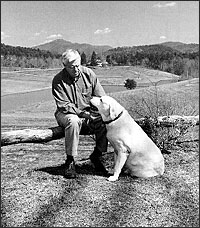 In Rabun County, Georgia, Loughlin has a property with an apple orchard and three ponds, where he plans to retire. |
 oughlin often begins meetings at 6:30 am and does not end his day until he has devoted time to his new managed care venture. Somewhere in all that activity, he takes a half hour each day to learn German. oughlin often begins meetings at 6:30 am and does not end his day until he has devoted time to his new managed care venture. Somewhere in all that activity, he takes a half hour each day to learn German.
After 34 years in practice, his idealism is still near at hand. He thinks often, for instance, about the contribution of astronaut Sonny Carter, who graduated from Emory College in 1969 and the School of Medicine in 1973. Having been the faculty adviser to Carter, who died in a commuter plane crash in 1991, Loughlin keeps two patches from his former student from the space program on his wall. "With warmest personal regards and sincere appreciation for your trusted guidance throughout my career," the inscription reads. When thinking of retirement, Loughlin speaks warmly of a property he co-owns in Rabun County that features an apple orchard and three fish ponds. Freshwater and Loughlin may not mix, however. He seems more at home in the briny waters where the big issues of the day are solved with perseverance and without fear. A smile is just visible on Loughlin's face as he recalls, "I think I gave [former Fulton County Commissioner and Atlanta mayoral candidate] Michael Lomax and others as much hell as they gave me." To give hell in ways that are fruitful for the community requires entering the salty waters at 6:30 am and dodging the barnacles all day long. The freshwater fish may have to wait. |
When I'm 94 | Love and Sex: The Vole Story | Salty Doc | The Quest for Excellence
Letters | In Brief | Development | Alumni News
Copyright © Emory University. All Rights Reserved..
Web version by Jaime Henriquez.